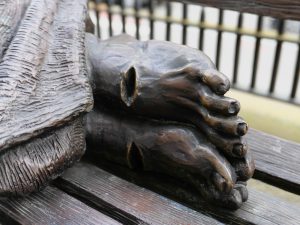
 About five years ago, one of my seminary classmates was on retreat at the Jesuit Retreat House in Los Altos, California, and he sent me a photo that shocked and disturbed me. It was a photo of a man sleeping on a bench in front of the retreat house. My heart was moved with compassion for this man. I was grateful that he found a safe place to rest. His head and most of his body were covered with a blanket and only his bare feet were visible. I zoomed in on the photo to discover that this was not a real person. It was a sculpture and as I looked more closely at the feet[2], I noticed the man’s wounds. They bore the signs of crucifixion. This was Jesus. The risen and glorified Christ depicted as a homeless man sleeping on a bench outside.
Jesus the Homeless[1] is a bronze sculpture by Timothy Schmalz that first appeared in 2013 at Regis College, a Jesuit institution that is part of the University of Toronto. Schmalz offered it to Cathedrals in Toronto and New York City, but they declined for various reasons. Many find the image too disturbing and controversial for their affluent Christian communities. But other communities were attracted to its shock value. Reproductions of Jesus the Homeless can be found all over the Americas, Europe, Africa, Asia, and Oceana today. The sculpture gained worldwide recognition when St. Barnabas Episcopal Church in Bay Village, Ohio installed the sculpture in their very affluent neighborhood. Within 20 minutes of the installation of the sculpture, someone called the police to report a homeless person sleeping on a bench. The news reporting of the incident highlighted American privilege, our indifference toward the issue of homelessness, and our contempt for the unhoused.
We have quite a shocking and disturbing parable from Jesus in the Gospel today. It’s quite a bizarre story. Like most of Jesus’ parables it not only invites us to see things in a new way, it detonates us from our complacency. As New Testament scholar Amy-Jill Levine argues, the parables of Jesus are intended to “afflict the comfortable.”[3] Jesus is trying to show us things we don’t want to see. What if we were to use “discomfort” as the interpretive lens for understanding today’s parable?
Let’s recap this crazy story. It’s a brutal horror story, steeped in violence and murder. The king is a nasty person. He decides to throw a wedding banquet for his son. Already, it is a story of affluence and privilege. I imagine that only the aristocracy are invited. They receive an invitation to the banquet and do the unthinkable. They refuse. In the ancient world, no one would refuse a royal summons. So, the king sends messengers to deliver a more enticing message. “Everything has been prepared for you! The oxen and fatted calves are ready for the table. It will be a lavish feast and quite a party!” But this group of aristocrats dismisses the invitation for a second time and kill the messengers. They don’t just say “no,” they respond with violence and murder. The king is enraged. He sends “his troops, destroys those murderers, and burns their city.” So, he uses his military to attack his own people, and he burns his own city to the ground. What an unpredictable, evil, and unhinged ruler he is. Despite all this death and destruction, he proceeds with the lavish banquet. He sends his slaves into the streets of the city he just destroyed to invite “everyone” to the wedding banquet. I don’t know about you, but if my home and everything I owned were just destroyed and I was climbing out of the rubble, I might not be in the mood for a lavish royal dinner party. The homeless people who survived the destruction of their city are gathered up and brought to the wedding hall against their will. Of course they’re not dressed properly! They only have tattered rags of devastation covering their bodies. We are told that the man without the proper wedding robe is thrown “into the outer darkness where there will be weeping and gnashing of teeth.”
What is going on here and what will disturb us enough to find the truth that Jesus is shocking us into?
This past Tuesday I led the parish Bible Study. I studied commentaries from five different scripture scholars who wrote about this passage. Each one urged against a traditional allegorical interpretation. I think we like simple allegories to make sense of this outrageous story. Remember, an allegory uses symbolic figures and actions to communicate a theological truth. The traditional allegorical interpretation is this. The king in the parable is God, the son is Jesus, the wedding feast is the heavenly banquet, the rejected and murdered slaves are the Old Testament prophets, and the aristocratic invitees who refuse to attend the wedding are God’s “chosen people,” the Jewish people. The last-minute guests who are gathered up from the streets are us -- the gentiles. This interpretation doesn’t challenge me a bit. It puts me in a place of privilege. It suggests that we are the ones who got it right. We correctly responded to God’s invitation. The Jews did not. We Christians got it right; the Jews got it wrong. To me, this is a horrible and sinful interpretation. Are we to really believe that God is this violent and unjust king? Interpretations like this contributed to the bloody history of the church’s abusive relationship with the Jewish people who are our spiritual ancestors. It is clearly anti-Semitic. Furthermore, it suggests that those who do not accept the invitation should die while we who say “yes” to the violent and murderous king should end up feasting in his safe and cozy palace while the world burns around us. How many times in history have we seen this scenario?
What is the truth that Jesus is shocking us into? Where is God found in this parable? How can this mirror the kingdom of heaven, as Jesus suggests?
I believe that the kingdom of heaven is found in the rejection of the king and the terror that comes with his abuse of power. God is the one who refuses the invitation of the evil despot. God rejects the king and all he stands for. For to accept the invitation to the wedding banquet is to participate in violence, murder, and abuse. What if Jesus is not the bridegroom, but the one without the proper wedding garment?[4] Jesus is the homeless man who was gathered up from the ashes of a burned-out city, who chooses the outer darkness to the complicity of a lavish, unjust banquet. For this is where God is found. The God of Jesus Christ is found in the outer darkness. Jesus is found in the darkness of Gethsemani, on the cross of Calvary, and in the lonely grave.
I’m sorry that this has been such a heavy sermon. Here is the Good News. God is found in the darkness of human life. God has visited every experience of human darkness – even suffering and death. If you have ever experienced darkness in your life, God is there. If you or anyone you love has ever suffered, God is there. God doesn’t just deign to visit you in your suffering–God is already there. We believe in a God who prefers a place of darkness to the lavish banquet table. The God of Jesus Christ dwells outside the banquet hall, in the darkness, where there is wailing and gnashing of teeth. Oh, God can be your king, but he reigns from a cross, not from throne. Jesus is not the bridegroom at a lavish banquet. He’s the unrobed guest. Jesus is the homeless man on a bench outside. He’s the improperly dressed dissenter who has been escorted into the darkness, bound and broken for the sake of love. May you find him there.

[2] Homeless.Jesus.Vancouver.Feet.P1022373.jpg (2368×1776)

[3] Levine, Amy-Jill. Short Stories by Jesus: The Enigmatic Parables of a Controversial Rabbi. New York: HarperOne, 2014.
[4] Debie Thomas suggested this interpretation in her essay, The God Who Isn’t, journeywithjesus.net.
Leave a Reply