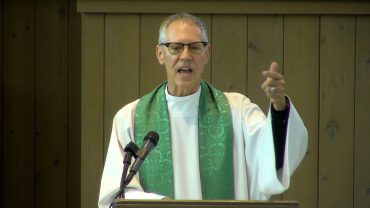
Matthew 9:35-10:8 [Jesus said to the twelve disciples, “A disciple is not above the teacher, nor a slave above the master; it is enough for the disciple to be like the teacher, and the slave like the master. If they have called the master of the house Beelzebul, how much more will they malign those of his household! “So have no fear of them; for nothing is covered up that will not be uncovered, and nothing secret that will not become known. What I say to you in the dark, tell in the
light; and what you hear whispered, proclaim from the housetops. Do not fear those who kill the body but cannot kill the soul; rather fear him who can destroy both soul and body in hell. Are not two sparrows sold for a penny? Yet not one of them will fall to the ground apart from your Father. And even the hairs of your head are all counted. So do not be afraid; you are of more value than many sparrows. “Everyone therefore who acknowledges me before others, I also will acknowledge before my Father in heaven; but whoever denies me before others, I also will deny before my Father in heaven. Do not think that I have come to bring peace to the earth; I have not come to bring peace, but a sword. For I have come to set a man against his father, and a daughter against her mother, and a daughter-in-law against her mother-in-law; and one’s foes will be members of one’s own household. Whoever loves father or mother more than me is not worthy of me; and whoever loves son or daughter more than me is not worthy of me; and whoever does not take up the cross and follow me is not worthy of me. Those who find their life will lose it, and those who lose their life for my sake will find it.”]
Doubling Down on Compassion
Matthew 9:35-10:8 [Jesus went about all the cities and villages, teaching in their synagogues, and proclaiming the good news of the kingdom, and curing every disease and every sickness. When he saw the crowds, he had compassion for them, because they were harassed and helpless, like sheep without a shepherd. Then he said to his disciples, “The harvest is plentiful, but the laborers are few; therefore ask the Lord of the harvest to send out laborers into his harvest.” Then Jesus summoned his twelve disciples and gave them authority over unclean spirits, to cast them out, and to cure every disease and every sickness. These are the names of the twelve apostles: first, Simon, also known as Peter, and his brother Andrew; James son of Zebedee, and his brother John; Philip and Bartholomew; Thomas and Matthew the tax collector; James son of Alphaeus, and Thaddaeus; Simon the Cananaean, and Judas Iscariot, the one who betrayed him. These twelve Jesus sent out with the following instructions: “Go nowhere among the Gentiles, and enter no town of the Samaritans, but go rather to the lost sheep of the house of Israel. As you go, proclaim the good news, ‘The kingdom of heaven has come near.’ Cure the sick, raise the dead, cleanse the lepers, cast out demons. You received without payment; give without payment.”]
SERMON TRANSCRIPT
It helps to know the whole story. Otherwise, it’s too easy to turn today’s Gospel into a “gotcha” moment and put Jesus or Matthew, our Gospel writer, on trial for smallness of heart.
Sound bites have always been dangerous. Taken out of context, Jesus sounds uncharacteristically stingy here – giving the disciples authority to heal the sick, but only within a certain radius. As a Gentile myself, I’m a little put off. Where does he get off telling them not to go to the Gentiles or Samaritans, as if there’s only so much compassion to go around?
On a human level, I get it. It’s hard to face the reality that some of us live long, healthy lives while others of us don’t. Sit with that injustice long enough, combine it with survivor guilt, and it stretches the limits of our compassion. Think about it. If we saw all the world’s suffering in real time, we wouldn’t be able to see anything else. No wonder we look for lines to draw – bloodlines or borders or political divides that can help us rank our loves and stop compassion from crushing us. I understand the impulse. It’s just not worthy of Jesus – or his followers.
To be fair, Matthew is the only Gospel writer to put these words in Jesus’ mouth. But even within his book as a whole, they don’t make sense – at least, not as a lasting directive. Gentiles are part of his telling of Jesus’ story from the beginning. It’s Matthew who brings the decidedly non-Jewish wise men into the Christmas story – Matthew who views Jesus as a light to the nations from the start. Matthew lifts up the faith of a Roman centurion and later a Canaanite woman, and his Jesus doesn’t withhold healing from either of them. And at the end of the book, it’s Matthew’s Jesus who tells his followers to make disciples of all nations. So then, why limit the scope of the disciples’ work at all?
Perhaps it’s because they don’t have the whole story yet. The good news of Jesus reaches its fullest meaning on the other side of Easter. Why go prime time when the story’s only half told? Or maybe this is Matthew’s attempt as a Jew to show God’s ongoing faithfulness to Israel – that God hasn’t left them for a younger model. It’s also possible, though, that Jesus is making a different point. It might have been easier for the disciples if Jesus had told them in this moment to go off on some foreign mission trip, so they could be their best selves with strangers who don’t know their whole stories. It’s a lot simpler to reinvent yourself as someone with authority when you can make a fresh start, when there’s no one to remind you of the fool you were before.
Jesus doesn’t let them ignore the suffering right in front of them for the sake of a clean slate elsewhere. Compassion does not end at home, but it might start there. Perhaps, in fact, it’s their closeness to their fellow lost sheep that makes healing here possible on all sides – the recognition of their shared brokenness, their inability to make a distinction between “us” and “them” that will finally break their hearts wide open and release the true power of compassion.
Or maybe Jesus is just seeing his disciples as they are and what they’re currently capable of. In slowing down the narrative and listing them by name, Matthew reminds us that Jesus, in fact, knows their whole stories and what they still need to learn. He won’t let them go off half-cocked into other cultures with their good intentions and nothing else. As many of us were reminded at yesterday’s anti-racism training, the work of building trust across communities that have historically been divided is hard and delicate. Cultural humility requires care, patience, accountability, and yes, compassion – things the disciples are nowhere near mastering at this point. Perhaps starting with a smaller circle is exactly how they’ll build their capacity to engage in the long, slow, real work of restored relationships and healing.
What does this have to do with us? I’m thinking about this in relation to our justice work as a cathedral as we deepen relationships with communities outside our walls – our migrant neighbors, the unhoused and addicted on our streets, those we’re trying to impact with our affordable housing project, our international mission partners. I’m also thinking about it in relation to how we care for each other up close in small groups, in home visits, in pastoral care – and how we treat those who disagree with us in any aspect of our lives.
In the onslaught of our 24-hour news cycle, compassion fatigue is real. It is a spiritual danger, and if we don’t stop and resist the snap judgments that come from sound bite-sized attention spans, we too will start looking for lines to draw. Fueled by fears of scarcity, we too might get drawn into narratives that guard our hearts by dehumanizing those whose suffering overwhelms us. It’s understandable; it’s just not worthy of us.
The good news: it’s not our only choice. We can step back and try to learn the whole story. We can remember that, as Paul reminds us in Romans, God’s love has already been poured into our hearts by the Spirit that’s been given to us. And that well is bottomless. It never runs dry. So, we don’t have to make ourselves feel better for our failures of compassion by putting others on trial. We don’t have to look for “gotcha” moments to ease our own consciences. And we don’t have to do any of this alone; in fact, we shouldn’t. We were never meant to carry the world’s pain alone. When we let our hearts break wide open together, the full power of God’s compassion is unleashed on this world– and we all find healing in the process. May it be so. Amen.
Your Faith Has Made You Well+ Rev. Adam Conley + June 7, 2026
Matthew 9:9-13, 18-26 [As Jesus was walking along, he saw a man called Matthew sitting at the tax booth; and he said to him, “Follow me.” And he got up and followed him. And as he sat at dinner in the house, many tax collectors and sinners came and were sitting with him and his disciples. When the Pharisees saw this, they said to his disciples, “Why does your teacher eat with tax collectors and sinners?” But when he heard this, he said, “Those who are well have no need of a physician, but those who are sick. Go and learn what this means, ‘I desire mercy, not sacrifice.’ For I have come to call not the righteous but sinners.” While he was saying these things to them, suddenly a leader of the synagogue came in and knelt before him, saying, “My daughter has just died; but come and lay your hand on her, and she will live.” And Jesus got up and followed him, with his disciples. Then suddenly a woman who had been suffering from hemorrhages for twelve years came up behind him and touched the fringe of his cloak, for she said to herself, “If I only touch his cloak, I will be made well.” Jesus turned, and seeing her he said, “Take heart, daughter; your faith has made you well.” And instantly the woman was made well. When Jesus came to the leader’s house and saw the flute players and the crowd making a commotion, he said, “Go away; for the girl is not dead but sleeping.” And they laughed at him. But when the crowd had been put outside, he went in and took her by the hand, and the girl got up. And the report of this spread throughout that district.]
SERMON TRANSCRIPT
Felicity Mae Ruby Kleve
How are you receiving the gospel this morning? How is your imagination processing the good news as you hear it pronounced by our deacon and lectors, or as you chant responses to the psalm, or as you read along in the service leaflet?
Matthew gives us three gospel tableaus in quick succession. The stories are brisk, told with brevity and yet brimming with an unshakable confidence in the power of Christ’s presence. Power to reconcile disparity in humanity; power to make us well.
I find myself contemplating the fringe of Jesus’ cloak as a pathway to wellness. We heard the story of the woman who trusts that Christ’s life-giving and healing love is as full at the periphery as it is at the center. Her singular courage reminds us to trust that God is with us at our fringes, our edges, our vulnerabilities, our failures, our suffering. In God’s hands, these become markers guiding our journey into the heart of Christ.
Felicity Mae Ruby Kleve found the fringe of Jesus’ cloak here at Saint Mark's when she started attending services last summer. The life and ministry of this cathedral parish community were a safe and stabilizing force in her otherwise troubled world.
I’m sharing what would normally be confidential pastoral information about a parishioner because her family has given their permission and because I know Felicity wouldn’t mind. Tragically, Felicity is no longer alive. She died at Harborview Hospital on May 11, the result of a terrible and tragic accident on a Lime bike.
Felicity’s father and sister from Kansas City knew she’d found a church home she loved. She talked about it with them a lot. But they never had a chance to learn the church's name while she could still communicate.
It’s a credit to Felicity’s Dad, Dan, that he reached out to every single one of Felicity’s social media contacts until he learned his daughter’s faith community was Saint Mark’s Cathedral. He did this in time to find me, and I had the privilege yesterday of leading a committal service for Felicity’s remains on a Bremerton ferry in the waters of Puget Sound and the Salish Sea.
Some of you knew Felicity. Many of you would recognize her. She was so outgoing and friendly. Wearing her big smile, she was unafraid to walk up to anyone to say hello.
She loved rainbows and color and was remarkably adept at assembling some – I’m gonna say – memorable gender-fluid outfits. Felicity was a trans woman in her 20s. The true name she found for herself – Felicity – perfectly suited her joyful personality.
Now, Felicity is helping us engage the good news of the gospel through the powerful witness of her too-short life.
I see parallels with the woman suffering a twelve-year health crisis. Healing for both includes trust in the Christ who draws us all from the fringes into the heart of loving community.
Felicity was having a rough time of it when she first started coming here. She was living in a shelter and hard up for resources. Her world was unstable.
Happily, a couple of months ago, she found her way into an Oxford House – a communal residential dwelling committed to shared goals and rules for maintaining sobriety from drugs and alcohol. Felicity was justifiably proud to be the first person ever admitted with a unanimous vote.
When Felicity died, she was two years into recovery after suffering the consequences and estrangements of her addiction for many years.
I honestly have so much respect for her because somehow she was able to remain sober while she was effectively homeless without stable housing. As someone also in recovery, I honestly don’t know if I could have done that without a roof over my head. I’m proud of you, Felicity.
Going back to church – this time an affirming church – gave Felicity fresh energy and purpose.
With God’s help, Felicity began to rebuild. She built upon the bedrock of her sobriety and her renewing faith. She found a stable home, she found stable people, and she found a stable job as a dishwasher at an exclusive eatery.
The deep source of Felicity’s joy in recent months was this cathedral community. She clung with all her might to the fringe of Jesus’ cloak as she found it here until it drew her, with the prayers and support of her faith community, into a season of wellness, of being made whole.
My friends, it is good to remember we are the fringe. We are all Christ’s holy fringe, and we helped Felicity find her footing as she did her own spiritual and practical work on her journey into wellness.
Felicity’s work was her faith in action. She trusted the gospel promise that we don’t, we can’t, do this work alone. Our help is in the God who comes alongside us in our suffering in the person of Jesus Christ, offering radical solidarity, radical wellness, radical hope, even if we but touch the hem of his robe.
“Take heart, daughter, your faith has made you well.” Jesus says this to the woman who stepped out of the harsh shadows and edges of her social isolation.
The text isn’t explicit about severe measures of ostracization, but we know that Levitical law pronounced her ritually unclean because of her relentless twelve-year bleeding trauma. This woman would have experienced great need, great loneliness, great suffering.
But she finds her way to Jesus, who says, “Take heart, daughter, [courage!], your faith has made you well.”
Your faith has made you well.
++
On a recent Sunday morning, Felicity wrote a poem about her newfound joy and peace in finding a spiritual home.
Here it is:
Sitting in the pews
used to be my least favorite
part
of every week
I just disliked it
I had been forced to go
and was largely surrounded by
people who looked at me in
judgment
It felt like an empty, cursed
place
But here at my church
I feel free, at home
I can be me and I feel so
Loved, accepted
Appreciated for who I am
What a dream
And I leave here each week
with peace in my heart
Love flowing through me
and I hear exactly what I need
to hear
God thank you for this place of
Peace
I can trust with holding my heart
God thank you
for you.
Felicity’s poem is a legacy gift to us. It bears witness to the fact that at Saint Mark’s we carry God’s grace not only to our familiar neighbors in the pew but also to seekers on the fringes. The gospel is alive here.
We are also wise to remember that Christ’s love desires to be known in the unfamiliar, maybe even sometimes uncomfortable, corners of our human neighborhood.
We must always welcome the stranger.
Felicity’s poem is also a challenge for the times we fail to seek out and acknowledge Christ in the stranger. How many Felicities come here only to leave, unable to find or grasp the fringe of Jesus’ cloak because, through inattention or fear, we’ve hidden it away?
Or how many wounded seekers find only the glittering vestments of our idols and insecurities, wrapped around some of us so tightly we have no freedom of movement or thought to contemplate anyone other than ourselves?
Thankfully, the gospel we carry to others is the gospel given to us, too. We don’t do this alone. Christ not only offers the fringes of his cloak but the fullness of his person. When we reach for him in faith, he responds by drawing us into the center of his sacred, loving heart.
The gospel came to the hemorrhaging woman just as it came to Felicity, and just as it comes to you and me. Reach for it, embrace it, and give it to the next Felicity you find who really needs it. The gospel is felicity. It will change your life.
THE imago DEI + Rev. Canon Rich Weyls + May 31, 2026
SERMON TRANSCRIPT
Matthew 28:16-20 [The eleven disciples went to Galilee, to the mountain to which Jesus had directed them. When they saw him, they worshiped him; but some doubted. And Jesus came and said to them, “All authority in heaven and on earth has been given to me. Go therefore and make disciples of all nations, baptizing them in the name of the Father and of the Son and of the Holy Spirit, and teaching them to obey everything that I have commanded you. And remember, I am with you always, to the end of the age.”]
In the name of the one, holy, and undivided Trinity. Amen.
Bishop LaBelle has released a pastoral letter on this Trinity Sunday, and he has asked that we read it at all our Sunday services. In the letter, Bishop +Phil offers some theological reflection on the Trinitarian mystery as it relates to a recent decision by our government regarding immigration. His letter is about five minutes long, so I will keep my reflections complimentary and brief.
First, two stories. When I was the Rector of St. Andrew’s Church in the Green Lake neighborhood, we took a group of teens to the San Diego-Tijuana border to learn more about immigration and the concerns of migrants. The most powerful experience I had during that trip was spending a night in a migrant shelter in Tijuana with people from all over the world who hoped to find a new home in the United States. My heart was moved by their stories, and I was astounded by their diversity and, at the same time, their similarity to me, their brother in the human family. We all wanted to live in a place of safety where we could provide for ourselves and our families. I felt a sense of unity in diversity as we shared meals together in a large dining hall. Because of that experience, immigration ceased to be a political issue for me. It became a human rights issue.
The next morning, we visited a huge urban farm where the migrants would work while they waited for their immigration interviews. The farmer was so proud of the large garden that was built over a reclaimed dump. He invited us to walk through the garden, to touch things, and notice. After some time in silent reflection, he announced, “Diversity is life. Without diversity, nothing survives.”
When I was being interviewed for a leadership position at the Providence-Swedish healthcare system, I was asked numerous times to “describe a time when you promoted diversity, equity, and inclusion in your workplace.” I answered several times. Then I was asked to explain my understanding of health equity. I said that I believed healthcare is a fundamental human right and that health equity is achieved when everyone can attain their full potential for health and well-being. I must have answered correctly. I got the job.
DEI – diversity, equity, and inclusion. At one time, DEI was a hallmark of life in corporate America, now it seems to be a dirty acronym. The winds have changed due to federal executive orders, changes in legislation, and corporate retrenchment. People throw around the term DEI, but rarely say the words, diversity, equity, and inclusion. Why wouldn’t anyone want diversity, equity, and inclusion in their workplace or for their fellow human beings?
I bring this up not to make a political commentary but to speak of the nature of God on this Trinity Sunday. Our readings today and our beliefs about the Holy Trinity teach us that the nature of God is community and relationship. God is a community of persons bound together in love. Our Trinitarian God is a unity of three persons who are defined by their diversity from each other – a diversity defined by their mutual relationships to one another. God is defined by relationships of innate diversity.
The Holy Trinity is also equitable. No person of the Trinity takes precedence over the other. All the persons are co-eternal and co-equal. They have different relationships to one another, but they are all the one true God. If you’d like to read a nice reflection on this, visit the Creed of Saint Athanasius in the Historical Documents section of your Book of Common Prayer (pages 864-865)1. Athanasius makes it quite clear that God is a community of co-equal persons.
God is inclusion. The nature of God is to include. Everything that God created is destined for union with God. God was entirely complete within Godself from before time began. But our creation story tells us that God created us out of love. God didn’t need us, but God loved us into existence. The incredible love that binds the three divine persons together spills out in creative action. Some say, God wanted something outside of Godself to love. And that love is creative and entirely inclusive. God loves all that God created. Nothing is excluded. All is destined for union with God.
To my mind, diversity, equity, and inclusion are attributes of the divine nature. They are the pattern of our existence and found naturally in all of creation. So, we can ignore and work against DEI or we can accept what really is. We can embrace God, or work against God. Our Genesis reading makes it abundantly clear that humans have been created in the image of God. What a gift! We are the image of God in the world, the imago Dei. The imago DEI.2 On this Trinity Sunday we pray together, “the grace of our Lord Jesus Christ, the love of God, and the communion of the Holy Spirit be with” us all evermore. Amen.
Catching Fire + Rev. Canon Emily Griffin + May 24, 2026
SERMON TRANSCRIPT
John 20:12-23 [Glory to you, Lord Christ. When it was evening on that day, the first day of the week, and the doors of the house where the disciples had met were locked for fear of the Jews, Jesus came and stood among them and said, “Peace be with you.” After he said this, he showed them his hands and his side. Then the disciples rejoiced when they saw the Lord. Jesus said to them again, “Peace be with you. As the Father has sent me, so I send you.” When he had said this, he breathed on them and said to them, “Receive the Holy Spirit. If you forgive the sins of any, they are forgiven them; if you retain the sins of any, they are retained.”]
What good is a gift if we don’t know it’s ours or what to do with it? On Easter night, Jesus says to his disciples, “As the Father has sent me, so I send you. Receive the Holy Spirit.” Sending implies movement. And yet, 50 days later, they’re still in the same room waiting for further instructions. While we’re dealing with different authors – John in the Gospel vs. Luke in Acts, the question remains: When will the Spirit finally catch fire in them and turn these followers into leaders? More to the point, when will it catch fire in us?
I’m asking on behalf of Charlie, Emma, Logan, and Miles – four spirited children who were baptized earlier this morning. They want to know what difference it makes to be “sealed by the Holy Spirit in baptism and marked as Christ’s own forever.” Or if they’re not asking that question yet – they will. Yesterday at baptism prep, I talked with them (and their parents and godparents) about the Holy Spirit – how it rides the invisible wind like a dove and comes to us whenever we need strength or power. We can’t see it directly, but we can know that it’s there. We see what it creates, how it fires us up and lights up the world.
The Spirit of God shows up throughout the Hebrew Bible. In our reading from Numbers, for instance, the spirit rests on people – but not in ways we can manage or control. It blows where it will, whether we’re outside the tent with Moses where we’re supposed to be or we missed the memo and are still inside the camp. God’s Spirit won’t stay in the channels we create for it, as helpful and holy as those channels may be. The Spirit is generous and playful. Likewise, in today’s psalm, God’s spirit is like an artist having fun – filling the earth with creatures, making Leviathan, that ancient sea monster, for the sport of it. And as for the Spirit in Joel (as quoted in Acts), it pours itself out on all flesh. It doesn’t discriminate by age or gender; it makes the young see visions and the old dream dreams. The Spirit of God is subversive, it’s creative, and it is radically inclusive; and it will not rest until we respond in kind.
Fast forward to Pentecost. The calm breath of Jesus in a closed room becomes a mighty wind that pushes the disciples out into the open air. It might be hard for us to picture what “divided tongues, as of fire” resting on them looks like, but it wasn’t for our 1st century audience. They saw it every day on the coin of the realm; a tongue of fire appeared above Caesar’s head on each coin, asserting his power as a son of the divine. Here the Spirit subverts that definition; now, real power rests on each of us. The Spirit gives us the power to speak truth when before we were silent; it gives us the power to lead when before we were content to follow. The Spirit is how we know that we are part of something bigger than those who look and sound like us. The Spirit makes us part of a covenant community whose loyalty transcends national boundaries, that can’t be limited to a single language or class or culture. The Spirit gives us the world.
So then, how do we know the Spirit when we see it? How do we know the gift is ours – or what to do with it? God’s Spirit shows up differently in each of us. See where you find yourself in what follows. Some might find it in a fiery passion for justice; for others, it might be in your clearheaded calm when the rest of the world is raging. We don’t have to choose one or the other as more valuable; we need both. We might find the Spirit in our knowledge born of dedicated study or in the wisdom wrought from hard-won experience. Our community needs both. For some of you, the gift of a rock-solid faith is what brings you to the table; for others, it’s your presence that somehow invites healing in those who are broken around you. Some easily discern what’s helpful or harmful and make decisions quickly; others of us can hold the space with patience while we wait for the community’s wisdom to emerge. Some have artistic gifts that can turn ideas into images and images into life; others’ playfulness and boundless energy point us to the One who created us for both.
The gifts are different, and they can change in us over time, but they’re all needed and they all require power. What’s fascinating to me is that God is the source of our dissimilarity. There is no one model we’re meant to conform to. This is good news for Charlie, Emma, Logan, Miles and all the rest of us who are baptized into the body of Christ. They don’t need to know everything to be faithful, and neither do we. They don’t need to have every skill or talent to be of use, and neither do we. At the same time though, they each have a unique power to act in this world, and so do we. When we’re sealed by the Holy Spirit in baptism, we are entrusted with a power that is subversive, creative, and radically inclusive – and at the same time, uniquely ours to use or to waste. That’s the difference that baptism makes, or at least one way that it shapes our lives – no matter how much time we have. Baptism names and celebrates the gifts that are already ours. There is a role that won’t be played in the universe unless we play it, unless we let the divine spark within us catch fire. In the Name of the One who has given us the Spirit and who can’t wait to see what we do with it together, Amen.