Matthew 5:1-12 -When Jesus saw the crowds, he went up the mountain; and after he sat down, his disciples came to him. Then he began to speak, and taught them, saying:
“Blessed are the poor in spirit, for theirs is the kingdom of heaven.
“Blessed are those who mourn, for they will be comforted.
“Blessed are the meek, for they will inherit the earth.
“Blessed are those who hunger and thirst for righteousness, for they will be filled.
“Blessed are the merciful, for they will receive mercy.
“Blessed are the pure in heart, for they will see God.
“Blessed are the peacemakers, for they will be called children of God.
“Blessed are those who are persecuted for righteousness’ sake, for theirs is the kingdom of heaven.
“Blessed are you when people revile you and persecute you and utter all kinds of evil against you falsely on my account. Rejoice and be glad, for your reward is great in heaven, for in the same way they persecuted the prophets who were before you.”
SERMON TRANSCRIPT
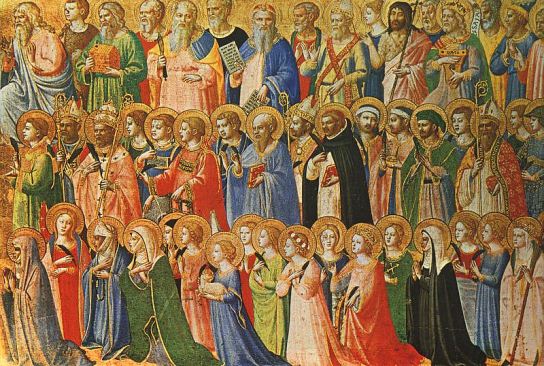
The history of this Feast of All Saints is an interesting tale with twists and turns that brings us together this morning, when we baptize our newest siblings, while also remembering the great cloud of witnesses whose lives have served as source of solace and inspiration across the ages. And we are invited to take our place in the mystical communion as well.
Having just returned from our pilgrimage to Greece and Turkey, it is worth noting that very early on, St. Paul saw fit to call all the faithful “saints”—not just those with some notorious contribution that is captured in scripture or the annuls of Christian history. Our church calendar is peppered with those folks’ stories, but we are invited to partake fully in the seasoned joy that is All Saints’ Day, saints in our own right.
By the Fourth Century, the Church saw fit to hold a day on which all the saints and martyrs were commemorated. In 735, Pope Gregory III set November 1st as the day for this celebration. In the 10th Century, monasteries across western Europe distinguished All Saints’ on November 1 from All Souls’ Day on November 2nd, a second day on which to remember our loved ones who had died.
For some, that morphed into praying to the dead as interceders on our behalf—a practice which did not set well with the Protestant Reformers five centuries later, so they reclaimed St. Paul’s impulse to call all the faithful hagioi1—saints—and elided the observance back to a single day, the first of November. The Feast of All the Saints. And here we are.
The Beatitudes have been intimately connected with this feast since at least medieval times, presumably because they name so clearly the virtues of saintly living. It is no accident, I think, that Jesus began his most extensive teaching discourse with this litany of blessings, which are as timely for us as they were for other generations.
Notice they are not imperatives—thou shalt live this way. They are declarative “if/then” statements—if they live this way, then they will reap this blessing. They are timeless in this regard, and I believe they speak profoundly into this crucible moment, when we, on the eve of an election in which we concern ourselves with present tense realities, can also lean into the eschatological hope of God’s reign for which we pray daily. Your kingdom come, your will be done, on earth as it is in heaven.
"Blessed are the pure in heart, for they will see God. These beatitudes beautifully hold the “now and not yet” nature of this spiritual life in the face of all that besets us. These are matters of the heart.2
I find myself thinking a lot about the future of democracy these days. Terry Tempest Williams wrote:
“The human heart is the first home of democracy. It is where we embrace our questions. Can we be equitable? Can we be generous? Can we listen with our whole beings, not just our minds, and offer our attention rather than our opinions? And do we have enough resolve in our hearts to act courageously, relentlessly, without giving up—ever—trusting our fellow citizens to join with us in our determined pursuit of a living democracy?”[3]
The disillusion with this political season especially has many of us asking, how then shall we live? What is to come of our nation, our society, our global humanity, all creation?
A Canadian citizen once said with good humor and affection for his neighbors to the south—America doesn’t do quiet discussions in the den; it prefers mud-wrestling in the living room.
Not a very beatific image, and we are left feeling dirty by it all. And perhaps afraid, and weary, and certainly disoriented as we search for a way forward.
How can we name these feelings honestly while also striving to have a hopeful perspective in this time.
When Jesus said "Blessed are the peacemakers, for they will be called children of God,” he didn’t say adhering to these virtues will inoculate us from the vagaries of this life. But he did foster an abiding sense of hope that the vagaries will not have the final word. God will. And we can trust in that even if we cannot yet fully see or comprehend what that may look like.
About a decade ago, Parker Palmer stood here in this cathedral, speaking of renewing democracy to a full room that I know included some of you—he was rather prophetic in what he had to say that day. He spoke of Habits of the Heart, which, if we practice them regularly, shape how we engage such times as these. Palmer offers these five habits:
- An understanding that we are all in this together. We are interconnected and interdependent.
- An appreciation of the value of “otherness.” The dualism of “us versus them” is a dead-end.
- An ability to hold tension in life-giving ways. Contradiction, paradox and mystery are important meaning-markers in our broken and imperfect lives.
- A sense of personal voice and agency.
- A capacity to create community4
At some level, these are the habits we espouse here, as a community of faith, referential to God who is the source of all that is good. We are invited to embrace these habits with intention in the days and weeks and months to come. We proclaim that politics in a democracy is not a zero-sum game, nor is it a winner-take-all contest; it is about consensus building, respectful listening, vigorous debate, and working for the common good.
We need not always agree, we frame this work by mutual affection and by the habit of prayer, trusting that God is calling us to our higher humanity, to embrace one another in our diversity and trust that we are the richer for such engagement.
It takes courage and commitment to engage in such a season of civility. What does it look like to lay claim to your agency in this work of civility and prayer, this work for the common good. To be sure, doing so won’t inoculate us from the vagaries of this life.
The saintly life is not about living perfect lives; it is about keeping perspective that God is working through us in greater ways than we could ever ask for or imagine. Blessed are the saints of God, for theirs is the kingdom of God. The faithful hagioi, as St. Paul said. You and me included.
Blessed are the saints of God, for you shall be a light to the world.
[1] The Greek word here is found in several of Paul’s letters and literally means “the holy ones” but he uses it to describe all the faithful followers of Jesus, not just famous ones.
[2] Exegetical and historical details about All Saints are drawn from https://www.workingpreacher.org/commentaries/revised-common-lectionary/all-saints-sunday/commentary-on-matthew-51-12-12
[3] From her book The Open Space of Democracy.
[4] http://www.wichurches.org/sitecontent/wp-content/uploads/2014/10/FiveHabitsoftheHeart.pdf
Leave a Reply