site-specific textile installation by Josh Faught
January 2017 – October 2018
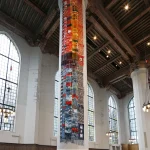 For Sanctuary, a commissioned work for Saint Mark’s Cathedral, Seattle, Josh Faught creates a textile that extends the length of the cathedral’s massive southeast pillar. Through woven texts, sheet music, DVDs, and archival documents affixed to the textile’s face, the work integrates popular and sacred music, a supernatural soap opera, and records of gay politics, sexuality, and culture in Seattle. Bringing together craft, sociopolitical, and personal histories, Sanctuary also links expressions of romantic and erotic love with songs of praise and prayers.
The work was hand-woven by the artist over the summer and fall of 2016, using hand-dyed cotton, hemp, and gold lamé. This abstract, painterly surface serves as a matrix and support for other found objects: novelty pin-badges, sheet music, magazines, and advertisements. Sourced from the artist’s personal collection and Seattle archives, these objects refer to cultural touchstones, political histories, pop culture, and jokes.
Running down the entire right side of the work are woven texts, each repeating the title of a song from Heaven on Earth, a 1987 solo album by former Go-Go’s singer and gay icon Belinda Carlisle. Each track on the album is structured like a traditional pop song, full of references to love and desire. Heaven on Earth can also be read as a thinly veiled hymnal; the continual use of second-person leaves open the identity of the “you” to whom each song is addressed. Every song has the potential to oscillate between earthly eroticism and sacred devotion. These texts are woven using a method called summer and winter, where two contrasting weft yarns in light and dark colors alternate to create a reversible pattern. This two-sided structure reminded the artist of the sides of a LP, and give a structure to the piece as a whole, which switches from predominant reds to blues halfway down as the song titles from the A-side of Heaven on Earth turn to those on the B-side.
On the other edge of the work, a column of pockets open up from the double cloth, holding a number of DVDs containing the complete first season of the cult-classic paranormal soap opera Passions (1999-2007). Set in the quaint New England village of Harmony, Passions opened up the typical range of soap operatic narratives by exploring supernatural realms. The melodrama of the soap opera, with its Mephistophelean villains and pure-of-heart young couples, was brought into new settings (hell, heaven) with higher stakes than fame, fortune, love and loss.
Between the smash hit and the soap opera, a set of objects are affixed to the textile like memoranda on a bulletin board. These mostly reproduce documents found in a pair of local archives kept at the Allen Library, University of Washington: the papers of Peter Hallock (1924–2004), organist, countertenor, composer, and founder and longtime director of Saint Mark’s lauded Compline Choir; and a large archive of correspondence, newsletters, magazines and fliers documenting LGBT politics and culture between 1964 and 1998, assembled by Tim Mayhew, a Seattle activist.
A manuscript of Hallock’s composition “A Song of Deliverance” connects the themes of Passions and Heaven on Earth to a more local, specific, and ecclesiastical context. Zines and ephemera from the Mayhew archive limn the mores of gay culture in the second half of the 20th century: the goofy-naughty Seattle zine Pot Pourri, with dispatches from pageants and boat cruises; a slip advertising “The Date-Record,” allowing men to call in their whereabouts on blind dates or hookups as a safety measure; advertisements for The Monastery, a notorious, long-since closed all-ages discotheque/church which gives its alternate name, “The Sanctuary,” to Faught’s piece. Founded in a deconsecrated church in 1978 by a complicated figure named George Freeman, the Monastery closed in 1985 after a series of police stings and court battles, when a Seattle judge gave Freeman a permanent injunction against operating any venue. In memorial articles published in The Strangerand other local papers, past attendees remember it variously as a den of sin and a safe haven, sometimes as both.
These disparate elements run through the weft and across the surface of Faught’s monumental weaving, setting up a complex chain of associations. Connecting various histories and objects in the matrix of a loom, Sanctuary opens a conversation between high and low, corporeal and insubstantial, secular and sacred.
Sanctuary was on view at Saint Mark’s Cathedral through July 2018. It was on exhibition at the University of Washington’s Henry Art Gallery in 2025.
About the artist
Josh Faught’s work explores conjunctions between various histories: the history of textiles, sociopolitical histories, and the artist’s personal history. Solo museum exhibitions include a site-specific installation at the Neptune Society Columbarium as part of the San Francisco Museum of Modern Art SECA Art Award Exhibition, and the Contemporary Art Museum St. Louis, both 2013. Faught is the recipient of the Betty Bowen Award at the Seattle Art Museum, 2009, the 2011 Louis Comfort Tiffany Foundation grant, and the 2012 San Francisco Museum of Modern Art Society for the Encouragement of Contemporary Art Award. He is an associate professor of textiles and fine arts at the California College of the Arts, San Francisco and Oakland.
About Western Bridge
Founded in 2004 as an art exhibition space in Seattle’s Duwamish industrial district, Western Bridge has operated since 2012 as an itinerant art initiative, commissioning work by artists including Josh Faught, Allyson Vieira, and Rob Fischer.
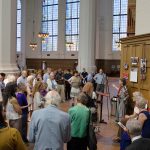 Inspired by Galatians 5:22-25, this is a colorful collection of images by cathedral member Sandy Nelson that illustrate the fruits of the Spirit. Each piece represents one of the fruits as written in Galatians with corresponding words from a hymn or scripture verse that relate to the larger word, creating an interesting composition of words and images. These are a powerful reminder of living, as guided by the Spirit!
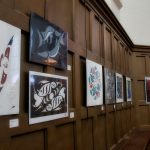
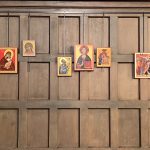 The Visual Arts Ministry presented an exhibition of a selection of sacred icons by Peter Pearson. There are 18 icons in total, each painted with acrylic paint on wooden panels using traditional Byzantine methods and varnished to protect the surface.
 Since 2018, the Stations of the Cross by artist